A Yoga Unit for Middle Schoolers: 6 Engaging Classes to Build Focus, Resilience & Empathy
Bringing yoga into middle school can feel like a big leap, but it doesn’t have to be.
When Ms. Riddle, a middle school wellness teacher, reached out to collaborate on a yoga unit, she had just completed her 200-HR Yoga Teacher Training (which was paid for by a parent-teacher association grant) and was eager to introduce yoga to her students. What she needed was an age-appropriate curriculum that made sense for her wellness center—and support in bringing it to life.
Together, we created a six-class yoga unit designed specifically for middle school students (6th to 8th graders). The result? Her students were engaged, her lessons were impactful, and her administrator had nothing but glowing feedback. (She said it was the first time she’d received an evaluation with zero areas for improvement—amazing!)
This yoga unit is ideal for wellness, PE, or advisory periods. It’s simple to implement and easy to adapt—no prior kids yoga experience is required. Read on for a sample yoga unit you can bring into your own middle school classroom.

Six-Class Yoga Unit for Middle School
Age Group: 6th Grade
Time: 55-minute class, 2 times per week for 3 weeks
Structure: Each class includes a theme, breathwork, warm-up, yoga sequence, and a closing meditation.
(Note: This Yoga Unit was piloted with 6th grade, but could be used with 7th-8th graders, as well.)

Class 1: FOCUS
Objective: To set the rules and expectations of the yoga class, show students how to use the yoga mats and yoga blocks appropriately, talk about how to stay safe during the movements, and discuss how to prevent injuries.
- Opening Discussion: What is yoga? What is an intention? Why do we warm up, and how do we stay safe? What are the rules of the class?
- Breathwork: Figure 8 Breath – Trace a figure eight in the air with your finger as you breathe deeply, focusing your eyes and attention on your finger.
- Warm Up: Introduction to Sun Salutations
- Yoga Sequence: Balancing Yoga Poses (to build mental focus and body awareness)
- Closing: Resting Pose (Savasana) + “Be Where Your Feet Are” Meditation

Class 2: SELF-CARE
Guiding Statement: “I take care of myself.”
- Opening Discussion: What is self-care, and why is it important for our overall health? What are the different ways we can practice self-care?
- Breathwork: Pause Breath – Place a hand on your chest, pause, and take slow deep breaths to calm your body and mind.
- Warm Up: Review of Sun Salutations
- Yoga Sequence: Calming and Energizing Poses (depending on class energy)
- Closing: Resting Pose + “Confidence” Meditation

Class 3: COMFORT ZONE
Guiding Statement: “I can grow outside my comfort zone.”
- Opening Discussion: What does it mean to be your authentic self? How can we practice authenticity? How does our school motto (“BERT”: belonging, empathy, respect, trust) relate to being true to oneself?
- Breathwork: Darth Vadar/Ujjayi Breath – Inhale and exhale through the nose with a slight throat constriction to create a calming sound and trigger the vagus nerve.
- Warm Up: Continue working on different Sun Salutation variations
- Yoga Sequence: Flexibility Poses (to stretch mind and body)
- Closing: Resting Pose + “Resilience” Meditation

Class 4: LETTING GO
Guiding Statement: “I let go of what no longer serves me.”
- Opening Discussion: How do we let go of grudges, negativity, or stress? What are hormones? Can we control our thoughts? Why do we want to control our thoughts?
- Breathwork: Extended Exhale – Inhale for three to five counts, exhale for six to ten counts.
- Warm Up: Continue working on different Sun Salutation variations
- Yoga Sequence: Hip-Opening Poses (to release stored emotion)
- Closing: Resting Pose + “Tense and Release” Meditation

Class 5: GRATITUDE
Guiding Statement: “I am grateful for my body, just as it is.”
- Opening Discussion: What does it mean to be grateful? What are the health benefits of practicing gratitude?
- Breathwork: Three Deep Breaths – Inhale through the nose and exhale through the nose three times.
- Warm Up: Continue working on different Sun Salutation variations
- Yoga Sequence: Core-Strengthening Poses (to build inner strength and stability)
- Closing: Resting Pose + “Be in the Moment” Meditation

Class 6: EMPATHY
Guiding Statement: “I understand and care about others.”
- Opening Discussion: What is empathy? How does stress affect our ability to connect with others? Why is being empathetic good for our health?
- Breathwork: Back-to-Back Breathing – Partner practice to cultivate connection, rhythm, and shared breath.
- Warm Up: Continue working on different Sun Salutation variations
- Yoga Sequence: Inversions (to practice shifting perspective)
- Closing: Resting Pose + “Body Scan” Meditation

Why This Yoga Unit Works for Middle schoolers
Ms. Riddle saw firsthand how these yoga classes helped her students manage stress, build resilience, and improve self-awareness. Here’s what she said:
“I got observed by our new assistant principal, and she had no negative feedback at all. This has never happened to me before in any evaluation.”
She also noted how meaningful the experience was for her personally:
“Thank you again for all your help and for being such a trusted resource. This curriculum has been invaluable.”

What Did Students Gain from the Yoga Unit?
To help assess the impact of this yoga unit, Ms. Riddle gave her students a pre-test and a post-test. The assessments measured how frequently students experienced feelings like worry, restlessness, and irritability, as well as their ability to manage stress. Here’s a look at what improved:
✅ Reduced Worry and Anxiety
The number of students who reported feeling worried or anxious several days, more than half the days, and nearly every day dropped from an average total (across three questions) of 45% in the pre-test to 36% in the post-test—a 9% decrease in overall worry and anxiety levels.
✅ Reduced Restlessness
Students who reported feeling restless on several days, more than half the days, and nearly every day decreased from an average total (across two questions) from 39% to 33%. That represents a 6% improvement in their ability to settle themselves.
✅ Reduced Irritability
Reports of students feeling irritable or easily annoyed several days, more than half the days, and nearly every day went down from 55% to 50%. This represents a 5% decrease in irritability.
✅ Increase of Tools to Manage Stress
When asked if they had been taught ways to manage stress, the percentage of students who said they agreed or strongly agreed increased from 50% to 62%, showing a notable 12% improvement in emotional regulation skills.
Additional Post-Test Questions
These two statements were included only in the post-test. Here’s how students responded:
- “I feel less stressed with Ms. Riddle’s yoga class.”
✔️ only 14% of students strongly disagreed or disagreed
✔️ 62% of students strongly agreed or agreed - “I will use some of the techniques taught to me in Ms. Riddle’s yoga class to help me feel better (body or mind).”
✔️ only 10% of students strongly disagreed or disagreed
✔️ 60% of students agreed or strongly agreed
These numbers tell a powerful story. Middle schoolers are often balancing big emotions, academic pressures, and social challenges. This yoga unit gave them the tools to slow down, tune in, and feel better in both body and mind.
Free Breath Poster + More!
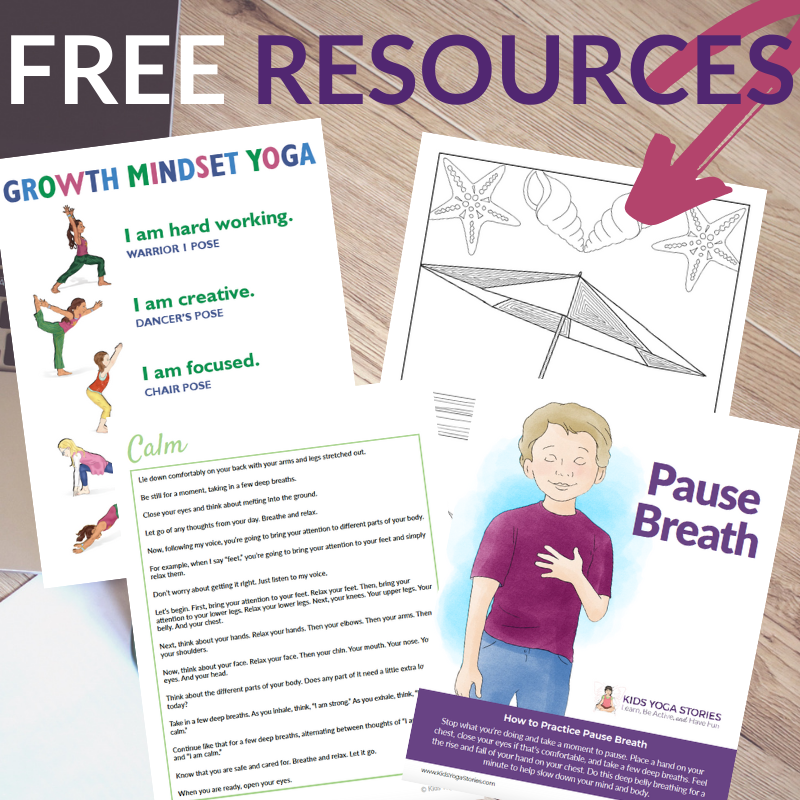
Bring the calming power of breath exercises to your classroom today!
Download this free Pause Breath Poster to share with your kids and as a little reminder for yourself to breathe!
How This Middle School Yoga Unit Aligns with MA Educational Standards
One of the highlights of this middle school yoga program is its alignment with both the Massachusetts Comprehensive Health and Physical Education Standards (MA) and National Health Education Standards (NPES). Ms. Riddle worked closely with her school’s wellness team to ensure that the unit meets grade-appropriate learning goals across multiple dimensions of student wellness.
The six-lesson yoga unit meets the following standards:
Health and Physical Literacy Focus:
- Skill Development: Students demonstrate appropriate form and alignment in a variety of yoga poses to ensure safety and effectiveness. (NPES Standards 1.8.3/1.8.4)
- Self-Expression: Students explore how being their authentic selves and practicing self-care enhances their participation in physical activity. (NPES Standards 4.8.1, 4.8.2)
- Health Connection: Students describe how yoga supports physical, emotional, and intellectual wellness, including managing stress, expressing gratitude, and cultivating empathy. (NPES Standards 4.8.3, 4.8.8)
Massachusetts Framework Connections:
- Mental & Emotional Health [6.2.MH]:
- Strategies for managing changing emotions during adolescence
- Stress management and coping techniques
- Growth mindset and perseverance
- Physical Activity & Fitness [6.1.PF]:
- Connections between physical fitness and emotional well-being
- Identifying areas of strength and setting goals for improvement
Key Vocabulary Students Learned:
- Sun salutation, physical postures, mindfulness, stress management, flexibility, strength, physical wellness, emotional wellness, intellectual wellness, alignment, and endurance.
This standards-based approach provided a strong foundation for integrating yoga into the school curriculum while making it relevant and meaningful to middle schoolers.
References:
National Health Education Standards
MA DESE CHPE Learning Standards

Would you Like to Build a Yoga Unit for Your School?
Whether you’re a wellness teacher, school counselor, pediatric therapist, or PE instructor, this sample yoga unit can be a helpful guide to introduce mindfulness, movement, and SEL to your students.
Need support creating or customizing your own yoga curriculum?
“My yoga curriculum was very good after I finished my 200YTT, but after working with Giselle, it became extraordinary. The way that she helped me organize it, theme it, and tie in the spiritual part of yoga while being age appropriate for middle school is what made the difference.
I still teach class the way I was taught in TT, but the mindfulness piece and the sequencing help from Giselle is what I needed to take it to the next level.”
-Ms. Riddle, Middle School Wellness Teacher
Check out our School Yoga Program for everything you need to create a customized yoga and mindfulness to your school community—complete with step-by-step modules, yoga lesson plan training, expert interviews, coaching calls with like-minded professionals, and much more.
👉 Explore the School Yoga Program here
MAY WE SUGGEST


YOU MIGHT ALSO LIKE
SAVE FOR LATER