Yoga for Non-Speaking Children with Autism: 6 Practical Tips
Discover yoga and mindfulness activities for non-speaking children with autism, including six practical tips, real-life stories, and inclusive teaching ideas.
This article contains affiliate links.
During my very first practicum as an elementary teacher in training, there was a child with autism in my classroom who sparked a curiosity that has stayed with me ever since.
I was fascinated by how his mind worked, how he engaged with classroom activities, and why connecting with other children seemed challenging for him. Most of all, I was curious about how he learned best and what we could do to help him thrive.
That experience led me to dive into research during my education degree, and my curiosity has only grown over the years. As an educator, I’ve always been passionate about finding ways to meet children where they are, honoring their individual learning styles, interests, and preferences. Every child deserves to feel that they belong, that they matter, and that they are a valued part of their classroom community.
Fast forward to today; that curiosity continues to grow as I parent my own unique daughter on the autism spectrum. She has been my greatest teacher and muse, expanding my mind and heart in ways I never could have imagined.
Over the past several months, I’ve been especially drawn to learning more about non-speaking children and youth with autism.
That curiosity led me to connect with Hope Martinson, an accessible yoga teacher and mother of two autistic young adults, one of whom is non-speaking. Hope recommended a book that deeply touched my heart: Ido in Autismland: Climbing Out of Autism’s Silent Prison by Ido Kedar (affiliate).
Even the subtitle stopped me in my tracks. Through his personal experiences, Ido shares the frustration of having so much to communicate while struggling to make himself understood. His story challenges our assumptions about intelligence, communication, and what we think we know about autism.
It also reminded me just how diverse the autism spectrum truly is. My daughter’s experiences and support needs are very different from Ido’s. And there are countless individual experiences in between. A single label can never capture the complexity of a person.
As I’ve continued learning, I’ve been deeply inspired by the stories of dedicated educators, therapists, and children’s yoga teachers in our Kids Yoga Stories community.

They’ve shared how yoga and mindfulness can create opportunities for connection, movement, communication, and self-regulation. From sound bowls and chanting to breathing exercises, sensory props, visual supports, and yoga postures on AAC devices, their creativity and dedication have been extraordinary.
I would love to share some of their stories with you, along with practical ideas you can explore with the children and youth in your life.
Understanding Non-Speaking Autism and Communication
One of the most important lessons I’ve learned is that not speaking does not mean not understanding.
Some autistic people communicate through spoken words, while others use gestures, signs, pictures, typing, or augmentative and alternative communication (AAC) devices. Some use several methods, and those methods may change depending on the situation.
AAC includes a wide range of communication supports, from simple picture boards to electronic speech-generating devices. These tools can help people express preferences, ask questions, share feelings, and participate in relationships.
When working with non-speaking children, we can begin by presuming competence, recognizing that they have thoughts, feelings, and ideas worth sharing, even when they communicate differently from us.
Real Stories from Our Kids Yoga Stories Community
1st Story: Hope Martinson, Presuming Competence and Finding Connection
Hope Martinson is an accessible yoga teacher whose passion for this work grew from raising two autistic children.
In our Kids Wellness Podcast interview, Hope shares a touching story about her daughter, who has significant motor challenges. When her daughter struggled with a shape puzzle, Hope adapted it to include numbers, something she loved. To Hope’s amazement, her daughter correctly identified the numbers she was asked to find.
It was a powerful reminder that someone’s ability to physically respond doesn’t necessarily reflect what they understand.
Hope brings that same philosophy into her yoga teaching. She created a yoga page on her daughter’s AAC device, complete with visual posture cards and programmed phrases, making it possible for her to participate in and potentially even lead a yoga sequence.
She also uses beanbags, blocks, breathing exercises, humming, books, and creative themes to help her students connect with their bodies. One of my favorite stories involves bringing fresh herbs and flowers into a chair yoga class. The opportunity to smell, touch, choose, and explore brought a wonderful level of engagement to the group.
Hope’s message is simple: presume competence, honor individual preferences, and create an environment where everyone feels welcome.
Watch my conversation with Hope Martinson: Yoga and Mindfulness for Non-Speaking Children with Autism

2nd Story: Patty McCarthy, Sensory Experiences and Communication
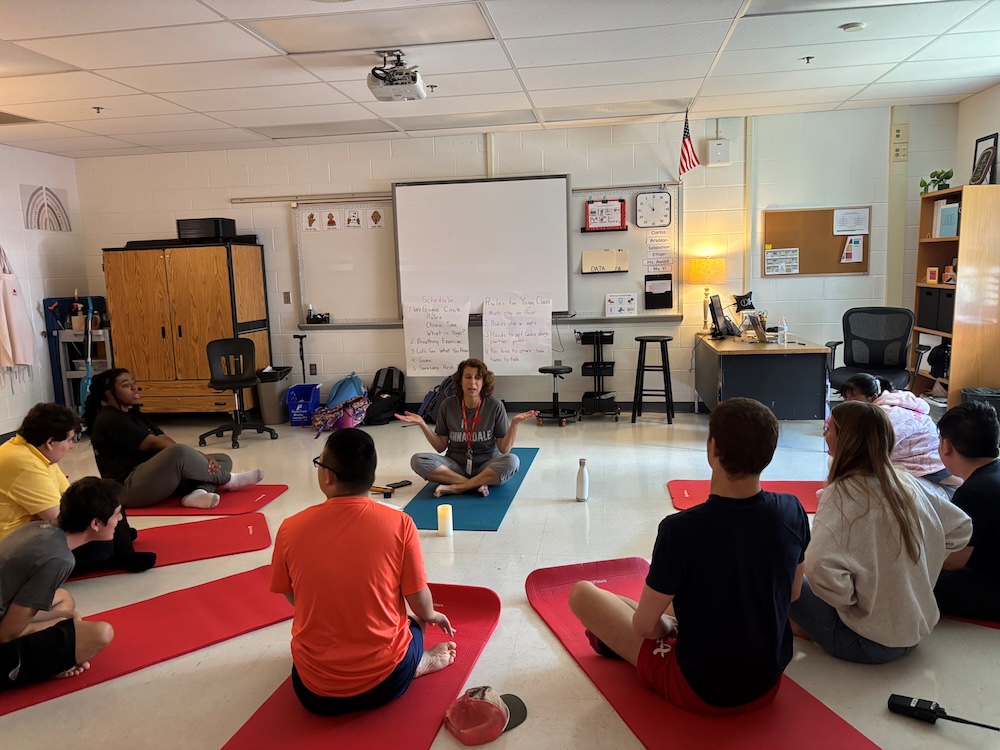
Patty McCarthy teaches yoga to high school students with autism and diverse learning needs. She shared how she adapts her weekly yoga classes for two non-speaking autistic students, who each have different communication and sensory preferences.
One student, who is also Deaf, loves dim lighting, projected stars, peacock feathers, and being wrapped snugly in a blanket during Savasana. Patty uses a small whiteboard, sign language support, and a visual schedule to help him participate.
Another student uses picture cards to make choices. When those aren’t available, Patty offers her hands as two response options, allowing him to indicate yes or no through touch.
What I love about Patty’s approach is that she doesn’t expect every student to communicate or participate in the same way. She simply finds creative ways to make the experience accessible.
Read more: Patty’s Yoga for Autism Classroom Story
3rd Story: Zivile, Keep It Simple and Follow Their Interests
Zivile, a School Yoga Program graduate, works with elementary-aged children in the United Kingdom, including children with complex communication and mobility needs.
Over four years of teaching yoga, she’s discovered that simplicity and repetition can make an enormous difference. Rather than introducing a long sequence, she might select just five accessible yoga postures and use a combination of large yoga cards, communication symbols, real objects, physical modeling, and Makaton signs.
For children who find structured movement challenging, she begins with short activities inspired by Attention Autism strategies, focusing on shared attention, engagement, and simple routines before gradually introducing yoga movements.
As the mother of an autistic daughter, Zivile also understands the value of following a child’s interests. Her daughter loves animals, nature, and music, so these become natural starting points for connection. Her story is a lovely reminder that we don’t have to begin with a complete yoga lesson. Sometimes one movement, one favorite animal, or one shared moment is enough.
4th Story: Julie Taylor, Exploring Sound and Movement
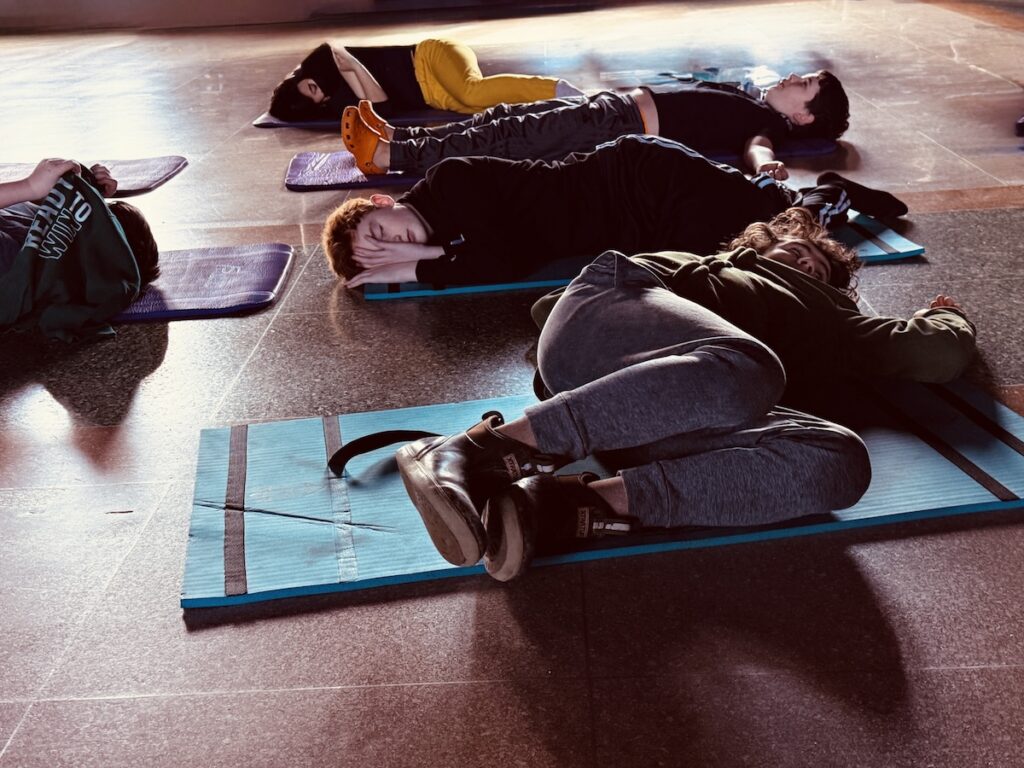
Julie Taylor, another School Yoga Program graduate, is a children’s yoga teacher whose work has been deeply shaped by her experiences raising her autistic son, Brandon.
Julie shares a deeply personal story about introducing gong sound sessions at home and witnessing changes in Brandon’s communication, including the emergence of spoken words. She considers sound an important part of his journey, and her experience inspired her to continue exploring yoga, meditation, and sound-based practices.
Today, Julie teaches yoga to children and adults with diverse abilities, incorporating enlarged visual posture cards, weighted stuffed animals, affirmations, sound experiences, and gentle relaxation.
Her approach reflects the importance of exploring what resonates with each individual and finding creative ways to support connection and well-being.
Read Julie’s full story: Yoga for Autism: A Teacher’s Story
6 Practical Yoga and Mindfulness Ideas for Non-Speaking Children
After hearing these stories, you might be wondering how to bring some of these ideas into your own yoga classes, classroom, therapy sessions, or home.
The wonderful thing is that many of these activities can be useful for all children, not just those who are non-speaking or autistic. You don’t necessarily need to overhaul your entire yoga lesson. Instead, think about how you can bring more curiosity, flexibility, connection, acceptance, and creativity to what you’re already doing.
1. Start with Connection and Their Interests
Before introducing a yoga posture or breathing exercise, take time to discover what brings the child joy.
Do they love animals, numbers, books, music, superheroes, or nature? Use those interests as a natural invitation to explore yoga.
Hope shared how she uses children’s books like From Head to Toe by Eric Carle (affiliate) to inspire movement. She also created Jedi Yoga activities using homemade lightsabers made from pool noodles!
Zivile uses animal themes to connect with her daughter, while Patty incorporates sensory experiences that her students genuinely enjoy.
Try this: Choose a favorite book, animal, or character and build a simple three-posture yoga sequence around it. Follow the child’s lead and notice what captures their interest.
2. Use Visual Supports and AAC Tools
For children who communicate without spoken words, visual supports can make yoga more accessible and predictable.
Yoga posture cards, picture schedules, communication symbols, and AAC devices can help children understand what’s coming next, make choices, and participate more independently.
Hope created a yoga page on her daughter’s AAC device. Patty uses picture cards and a whiteboard, while Zivile combines yoga cards with Widgit symbols, objects, modeling, and Makaton signs.
Try this: Display three yoga posture cards and invite the child to choose which one to practice first. Offer choices through their preferred communication method, whether that’s pointing, eye gaze, signing, typing, or using an AAC device. If the child already uses AAC, work with their family or communication team to incorporate familiar tools.
3. Explore Sensory Props and Tactile Experiences
Sometimes a simple prop can make movement more meaningful.
Hope uses beanbags and yoga blocks to provide tactile cues. Instead of asking a student to lift their right hand, she might ask them to lift their “beanbag hand.” She also encourages students to press their hands into a yoga block to explore muscle activation and body awareness.
Patty uses peacock feathers and blankets, while Julie incorporates weighted stuffed animals into her yoga sessions. These tools can help make abstract movement instructions more concrete and engaging.
Try this: Offer a beanbag, soft toy, feather, or yoga block during a familiar yoga posture. Invite the child to explore the object and notice how it feels. Always respect sensory preferences and allow them to decline. Ask permission before providing physical assistance or touch.
4. Experiment with Breath, Sound, and Vibration
Breathing exercises and sound-based activities offer opportunities to explore body awareness and self-regulation.
Hope uses simple prompts such as smelling a flower and blowing out a candle. She also practices what she calls “body breaths,” inviting students to place their hands on different parts of their bodies while making gentle vowel sounds or humming. Julie incorporates sound experiences, including gongs, into her yoga and relaxation practices.
These activities can be especially engaging when we allow children to experience sound and vibration in ways that feel comfortable to them.
Try this: Hold a feather and invite the child to notice how it moves as they gently exhale. Or explore humming while placing their hands on their chest to feel the vibration. Children can also simply listen, watch, or participate without making a sound. Keep sound levels comfortable and offer a quieter alternative for anyone who finds sound overwhelming.
5. Keep Routines Simple, Predictable, and Flexible
Many children benefit from knowing what to expect, particularly when navigating communication or sensory challenges. Zivile often begins with just a few yoga postures and repeats them regularly. Patty uses visual schedules, while Hope creates familiar sequences that students can anticipate. But predictability doesn’t mean rigidity. Sometimes the most meaningful learning happens when we’re willing to change our plans.
Try this: Create a simple routine with a greeting, three yoga postures, one breathing activity, and a closing relaxation. Use visual cards to show the sequence, and be ready to shorten, adapt, or change it depending on the child’s needs that day.
6. Create a Welcoming Space and Celebrate Every Form of Participation
Perhaps the most important lesson from these stories is that participation looks different for everyone.
Hope shared that some students attend her yoga classes regularly but prefer to sit and watch. And that’s absolutely okay! A child might explore a prop, listen to music, observe a movement, make a choice, or join in for just a few moments. These are all meaningful ways to participate.
We can also consider the environment itself. Is the lighting comfortable? Is the room too noisy? Would the child prefer to sit beside us rather than face-to-face? Are there opportunities to take breaks?
Try this: Before your next yoga class, think about one small adjustment that could help a child feel more comfortable and included. It might be offering a choice, changing the lighting, adding a visual schedule, or simply allowing more time to respond.
Remember, the goal isn’t perfect yoga postures or complete participation. It’s connection, belonging, and creating positive experiences with movement and mindfulness.
Recommended Resources for Learning More
Ido in Autismland: Climbing Out of Autism’s Silent Prison by Ido Kedar
Find the book here (affiliate)
This deeply moving book, written by Ido Kedar when he was a young teenager, offers a personal perspective on growing up as a non-speaking autistic person.
Ido describes the frustration of having so much to communicate while being underestimated by the people around him. His experiences with communication barriers and educational approaches challenged many of my assumptions about autism.
It’s both heartbreaking and heartwarming, and the subtitle, Climbing Out of Autism’s Silent Prison, has stayed with me.
Non-Speaking Writers and Advocates
Hope Martinson also recommended exploring the work of these writers and advocates to learn more about non-speaking autism and the experiences of autistic individuals and families:
- Danny Whitty, known as Danny With Words
- Niko Boskovic
- DJ Savarese, writer and co-producer of the autobiographical documentary DEEJ
- Jordyn Zimmerman, @jordynbzim
- Tiffany Hammond, known as Fidgets and Fries, and author of A Day With No Words, a children’s book about her non-speaking son who uses AAC
Their stories offer valuable opportunities to broaden our understanding of communication, accessibility, and inclusion.
The Telepathy Tapes Podcast
For those interested in exploring the wider conversations surrounding non-speaking autism, The Telepathy Tapes offers a thought-provoking look at the experiences of families with non-speaking autistic children and youth.
I found the stories fascinating and deeply moving. However, the podcast also explores controversial claims about telepathy that have not been scientifically established. It’s a resource to approach with curiosity, critical thinking, and skepticism rather than as guidance for supporting communication.
Curiosity, Connection, and Belonging
The more I learn about non-speaking autism, the more I’m reminded that we don’t need to have all the answers. We need to stay curious. To listen, even when communication doesn’t happen through spoken words. To notice what brings a child joy, what helps them feel comfortable, and what sparks their interest. To be flexible when something doesn’t go as planned. To try again, in a different way, on a different day.
And most importantly, we must remember that every child deserves to feel seen, valued, and included.
These stories have reminded me that inclusive yoga doesn’t have to be complicated. Often, it’s the simplest adaptations, offered with patience, creativity, and genuine connection, that make the biggest difference.
And isn’t that what yoga is really about?
MAY WE SUGGEST


You Might Also Like
SAVE FOR LATER